Which Man is Blind?
A few days ago I listened to an interview by Alex O’Connor (YouTube) with the Hindu monk Swami Sarvapriyananda (Wikipedia) (Swami in his name is a title, much like a Father or Bishop in Christian practices).
In the interview, Swami Sarvapriyananda mentioned an old Buddhist parable, the blind men and an elephant (Wikipedia). The poet John Godfrey Saxe (Wikipedia) most famously introduced the parable to western audiences.
It was six men of Indostan
To learning much inclined,
Who went to see the Elephant
(Though all of them were blind),
That each by observation
Might satisfy his mindMoral:
So oft in theologic wars,
The disputants, I ween,
Rail on in utter ignorance
Of what each other mean,
And prate about an Elephant
Not one of them has seen!
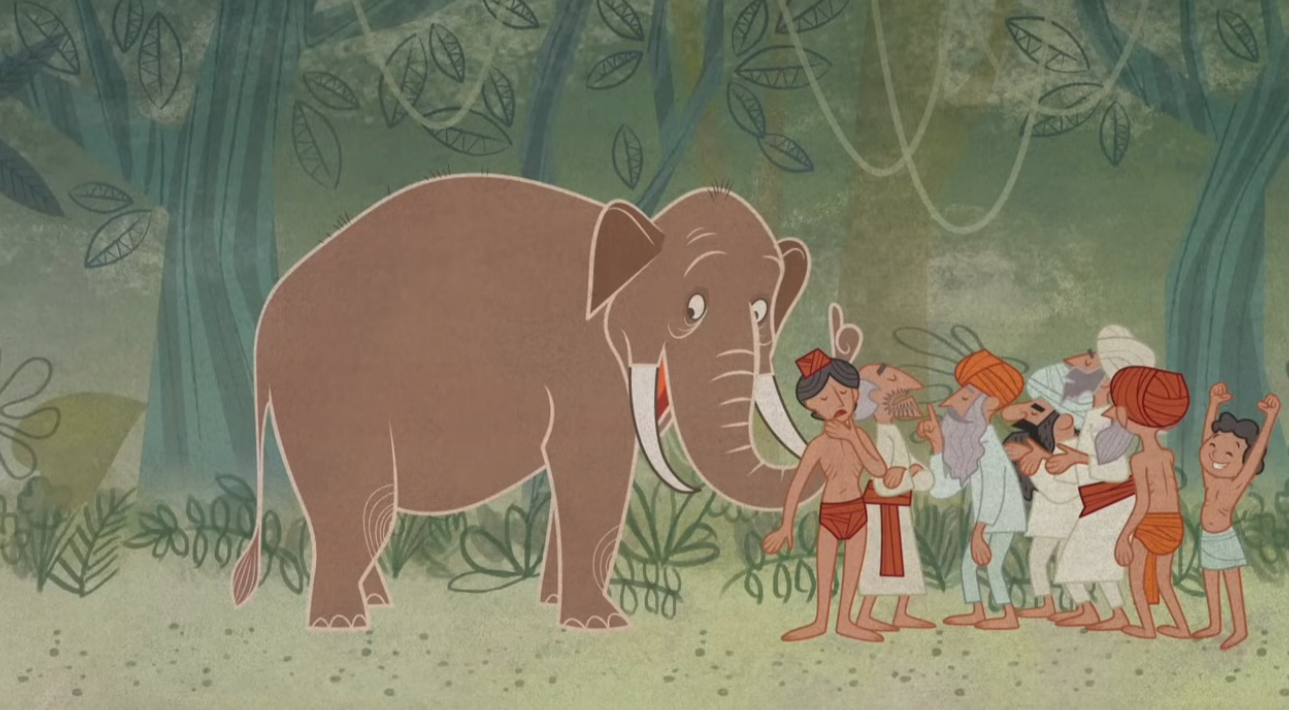
I suprisingly recognized the parable, from a much earlier time in my life, from a very different source. I could even picture the animated elephant with the westerner’s stereotypical depiction of “Indians” (eastern kind) grasping at its parts.
The Whole Truth
In Dieter F. Uchtdorf’s talk (speeches.byu.com), to students of Brigham Young University, an apostle of the Church of Jesus Christ of Latter-Day Saints spoke about the importance of seeing the whole Truth.
The thing about truth is that it exists beyond belief.
The church later made a short animated video, clipping up his talk in a nice portable format that I remember watching many times as a kid. Growing up, Sundays were special days, so YouTube was only kocher on a church affiliated channel. I had watched each of those videos many times over. 😁
I reflected today on the possibility that this parable of the elephant may have been misconstrued or appropriated by Uchtdorf for his, or more generally, for the church’s, purposes. I wondered how exactly he had presented the parable those years ago, and if it matched its original intended purpose.
I think my gut instinct was to use this as some sort of fodder. Pointing out a mistake on the part of Uchtdorf could really reaffirm my decision to step away from the mormon faith. On further reflection and researching for this post, I think it makes more sense, and is intelectually more honest, to compare how this story has been applied. As Wikipedia states, the parable “has been used to illustrate a range of truths and fallacies”.
And isn’t that how parables, allegories, and friends all work? We mold them to our time. The cultural morays shape the parts of the elephant the blind men see. For the 500 B.C.E. crowd its a plowshare, a mortar, and a pestle, and for us modern folk, a spear, a tree, and a snake; for an elephant’s tusk, leg, and tail respectively.
Ancient Elephants
In the earliest version of the parable, found in the Tittha Sutta 6.4 (accesstoinsight.com), the Buddha highlights the flawed position of the sages in his day:
In the same way, monks, the wanderers of other sects are blind & eyeless. They don’t know what is beneficial and what is harmful. They don’t know what is the Dhamma and what is non-Dhamma. 1
Buddha here clearly seems to indicate he sees the elephant for what it is, not these monks of other sects.
And what about my favorite German pilot?
Modern Parables
Other than taking a strong position against Flat Earthers:
For example, in spite of one-time overwhelming consensus, the earth isn’t flat.
Utchdorf claims there is such a thing as absolute truth. And this truth, like seeing the whole elephant clearly, “is His gospel. It is the gospel of Jesus Christ. Jesus Christ is ’the way, the truth, and the life.'”
The Battle for the Elephant
And so it seems, from my cursory investigation, that this parable has been used by each to advance their own perspective, which is ironic.
Not sure why the thought crossed my mind, but I’m trying to write everyday, and so I thought it’d supply an interesting lens into my mind these days.